Getting young people to participate in online is something that is hard to get them to do of their own free will. The best way is o use a site that they are already using, such as reddit, and getting a popular poster to get it started. If it is already popularized it is more likely that the youth will participate. Faking comments is a typical thing to do now, especially for things like yelp and other review systems. This gives them a better score than they would normally have, and if they are the only reviews, and get people in the door.
Chapter 5: "They also participate in these American SNSs to disembed themselves from their Japanese uchi and have a chance to express themselves free from Japanese cultural norms."
This is an interesting concept, but I have seen the opposite happen. American youth participating in Japanese culture in various ways. Most of this intrigue seems to be related to their obsession of anime and manga. For the Japanese it seems to give a liberating feeling. The ability to express themselves the way they want.
Chapter 6: "Characterizing young learners as a homogeneous group through the use of terms such as “Digital Natives” is problematic for a number of reasons, but the main one is that through a broad generalization such terms gloss over the need to identify and recognize difference."
This quote goes with what I have been talking about throughout my posts and it is nice to see that the author agrees with my thinking. I knew I couldn't be the only one. Like taxonomy in biology, it is important to categorize things with precision.
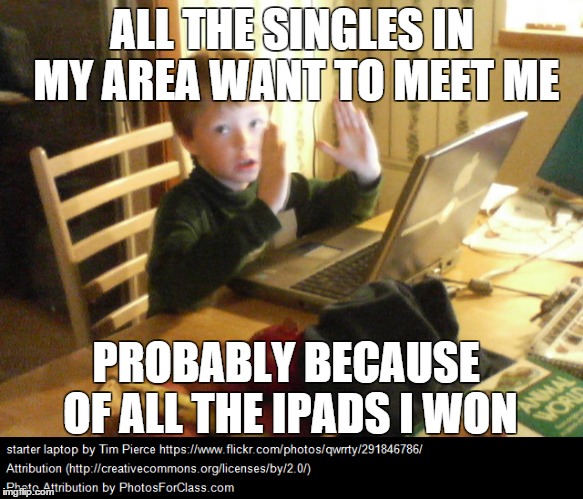
This shows a bit of the learning curves associated with getting onto the internet for the first time. All of the ads and pop-ups can be overwhelming. Without any guidance someone ma not assume that these are a ploy to lure people in.


Your meme is so funny! I can see how it would be confusing to new users of the internet to be confused by all the pop-up adds thinking that they are legitimate. I can say when I was 10 or 11, when the internet and AOL were just becoming popular with children, I thought that I won something as well. It can be deceiving. You really have to be wise in a different way to be literate about technology. it just goes to show that like your last quote, we are all intelligent in different ways and shouldn't be measured by the same standards. Your quote and comment from chapter four really makes people look silly, having to create fake comments on their sites, obviously young people are not as interested in politics online as older generations.
ReplyDeleteYour Meme is pretty funny. I like how you thought to poke fun at those annoying pop-up ads. They are something I have grown to ignore now (except the ones with sound, those I get rid of), but I can remember reading every single one when I was younger. The bright colors and flashing pictures really sucked me in as a kid; I’m sure they’ve gotten a lot better at luring kids in.
ReplyDeleteI agree with your responses to all the quotes you chose. I particularly like the chapter six quote and response you gave, “Like taxonomy in biology, it is important to categorize things with precision.” Why is it that when it comes to categorizing animals, we are so precise, yet we can lump whole generations into just one category?
I thought your Meme was funny to, it made me think about the pop ups on my phone when someone invites me to play a game online. I hate them.
ReplyDeleteI gravitated toward your quote from chapter 5, I remember watching 60 minutes and the Japanese youth culture when texting first came out this was way before it hit the states.
One of the reporters spoke about how the young people used their phones for texting and sharing all kinds of information but it was more for their self expression.
So you are right Sean, They wanted to disconnect from their everyday culture and explore other area's of interest. I remember the reporter interviewing students who were discussing a comic book called death note via chats and text. This is the equal of anime and manga for kids here in the states.
Thought it was a great comparison to what you wrote.
DeleteI loved your Meme, it made me laugh. I feel that there are always pop ups or adds for dating sites or to win free stuff online. You grow to ignore them and tend to forget about them, but they still exist. I think their are not as many and as flashy as they use to be.
ReplyDeleteI like your quote from chapter 5. I think that it clearly shows how connected cultures have become because of new digital technology that makes it possible to connect with others around the world and find information about these other cultures. Also, like everyone else, I found your meme hilariously accurate. I get so sick of all of the ads everywhere online! I think you are right, though, that there is a certain responsibility we have to educate new digital users of these hoaxes.
ReplyDelete